GEO vs SEO: What’s the Difference in 2026?
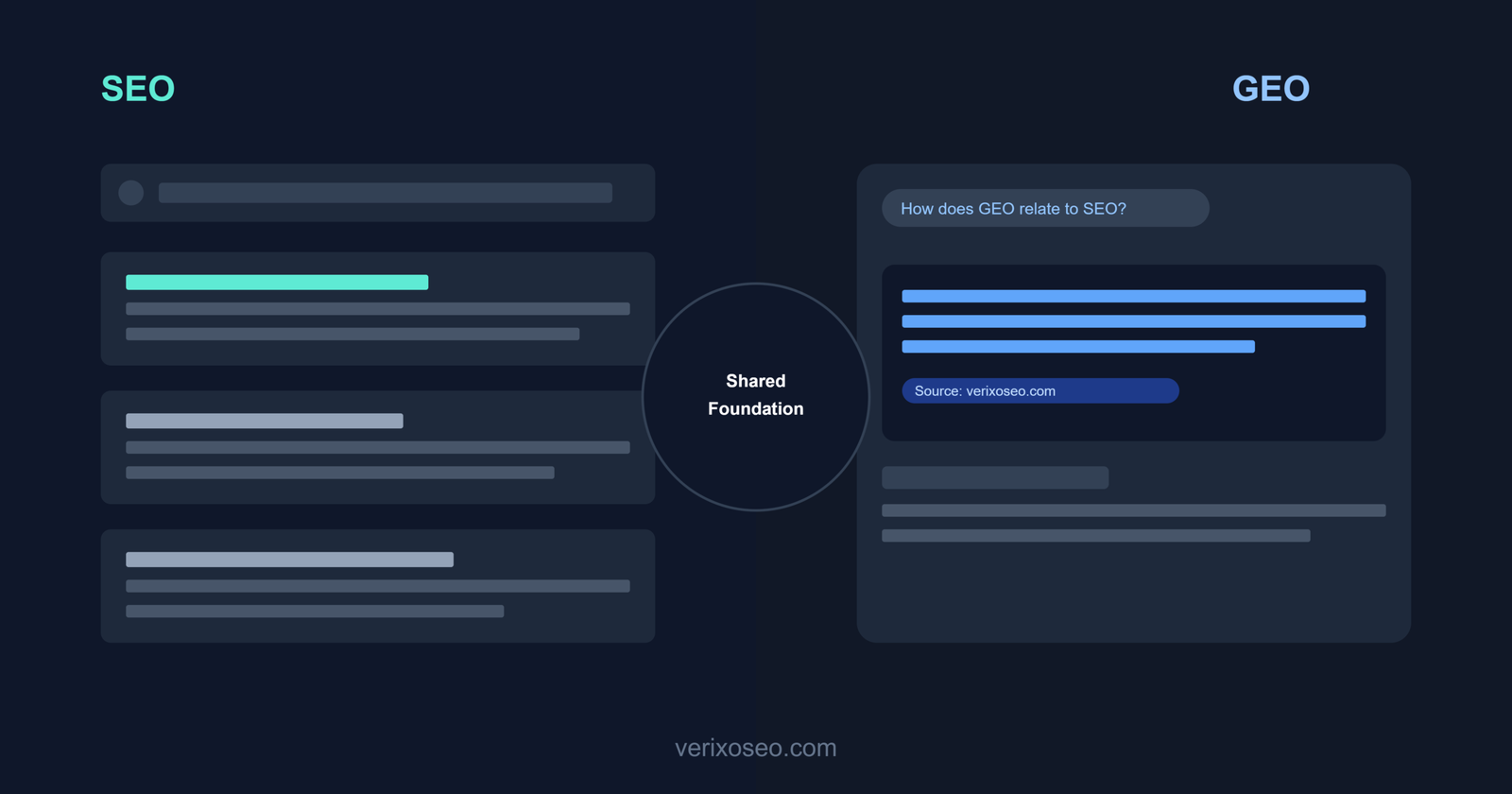
GEO (Generative Engine Optimization) is the practice of improving how a brand appears in AI-generated answers, while SEO (Search Engine Optimization) is the broader practice of improving a site’s visibility across all of Google Search, including generative AI features. They are not competing strategies. Google has stated directly that optimizing for generative AI search is optimizing for the search experience, and is still SEO. GEO and AEO describe a focus area within SEO, not a separate discipline that replaces it.
Why This Question Matters Now
Search results look different than they did two years ago. AI Overviews sit above traditional listings on Google. ChatGPT, Perplexity, and Gemini answer questions directly instead of returning ten blue links. Business owners are asking a reasonable question: does the old SEO playbook still work, or do they need something new called GEO?
The honest answer requires nuance. Google published an official guide in May 2026 addressing this exact question, and the answer from the source that controls the largest share of search traffic is clear: the fundamentals have not changed as much as the marketing around them suggests.
SEO vs GEO: The Short Answer
SEO and GEO are not two separate systems competing for your attention. SEO is the umbrella discipline: making a website easy to find, crawl, understand, and trust across every way people search, including typed queries, voice search, and now AI-generated answers. GEO is the term the industry uses for the subset of that work focused specifically on visibility inside generative AI experiences.
The overlap is large. The differences are mostly about emphasis, not method.
| SEO | GEO | |
|---|---|---|
| Primary goal | Rank in traditional search results and all Search features | Get surfaced or cited in AI-generated answers |
| Search environments | Google Search, Bing, image/video search, Discover | AI Overviews, AI Mode, ChatGPT, Perplexity, Gemini, Copilot |
| Optimization focus | Keywords, intent, technical health, links | Clarity, extractability, entity recognition, direct answers |
| Content approach | Comprehensive pages targeting search intent | Same, with emphasis on scannable, quotable sections |
| Technical requirements | Crawlability, indexability, page experience | Same technical baseline; no separate technical standard exists |
| Authority signals | Backlinks, brand mentions, expertise, reviews | Same signals; AI systems draw on the same web of trust |
| Measurement | Search Console, rankings, organic traffic | Search Console’s Generative AI performance report, referral traffic, still-developing citation tracking |
| Main similarity | Both depend on being indexed, crawlable, and genuinely useful to the person asking the question |
What Is SEO?
SEO is the practice of making a website easier for search engines to find, understand, and recommend to people. It is broader than most people assume, and it was never only about ranking blue links.
A complete SEO strategy includes several connected parts:
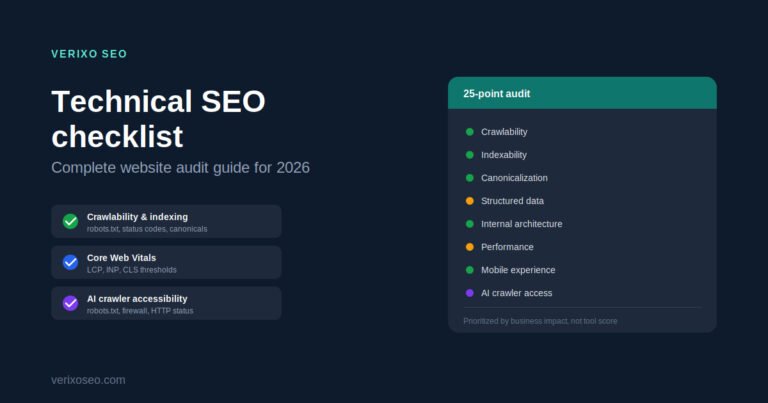
Technical SEO covers whether search engines can actually access and process a site: crawlability, indexability, site speed, mobile usability, and a clean site structure.
On-page SEO covers how individual pages are built: title tags, headings, internal linking, and content that matches what someone is actually trying to accomplish when they search a given phrase.
Content strategy covers whether the site has genuinely useful material covering the topics its audience cares about, organized in a way real readers (not just algorithms) can follow.
Authority and links cover how the rest of the web references a site. Backlinks, brand mentions, and third-party validation all signal that other sources trust the content.
Search intent means matching content to what a searcher is actually trying to do: learn something, compare options, or make a purchase.
SEO now supports visibility across every Google Search experience, not a single results page. That includes traditional listings, Google Images, Google Discover, local results, and generative AI features like AI Overviews and AI Mode. Measurement traditionally runs through Google Search Console and analytics platforms tracking organic traffic, rankings, and conversions.
What Is Generative Engine Optimization (GEO)?
GEO is the term that emerged as AI-generated answers became a meaningful part of how people search. It refers to work aimed at improving how a brand or piece of content appears when an AI system generates a summarized answer instead of a list of links.
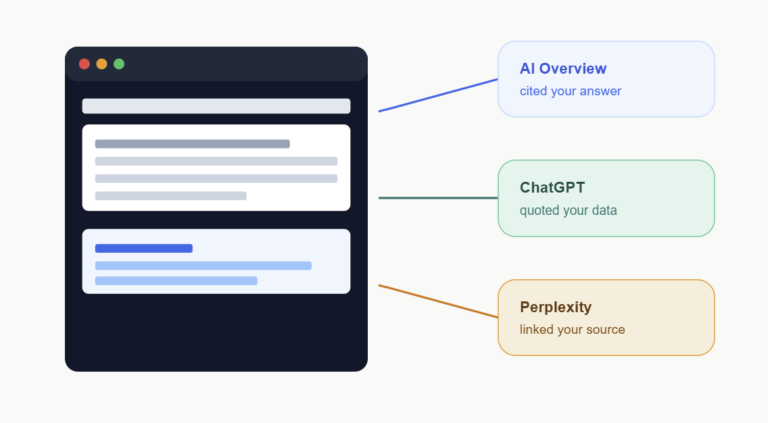
This includes visibility inside AI Overviews and AI Mode on Google, answers generated by ChatGPT search, responses from Perplexity, and similar AI-assisted research and recommendation experiences. In some of these systems, being referenced or linked as a source is part of the visible outcome. In others, the underlying content may inform an answer without a visible citation at all.
It’s important to be precise about what GEO actually is. It is an industry framework and a useful way to talk about a specific goal, not a distinct technical system with its own ranking algorithm. Google has been direct about this: from its perspective, optimizing for generative AI search is optimizing for the search experience, and is still SEO.
What Is Answer Engine Optimization (AEO)?
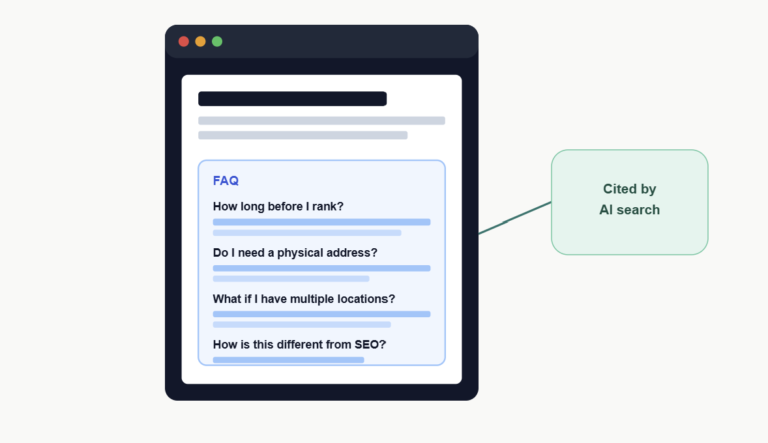
AEO refers to structuring content so it can directly answer a specific question, clearly and concisely, in a format that’s easy to extract and reuse. This includes writing direct definitions, clear comparisons, well-organized FAQ sections, and content that answers a question in the first few sentences rather than burying the answer under a long introduction.
AEO overlaps heavily with both SEO and GEO. Clear, well-structured answers have always helped traditional SEO, since they improve readability and match how people phrase search queries. That same clarity also happens to make content easier for AI systems to summarize accurately. AEO isn’t a separate technical discipline: it’s a content-writing discipline that supports both older and newer forms of search visibility.
GEO vs SEO: 7 Key Differences
The overlap between SEO and GEO is substantial, which is worth repeating before listing differences that are mostly about degree and emphasis, not fundamentally different mechanics.
1. Search Result Format
Traditional SEO optimizes for a results page: a list of ranked links, each competing for a click. GEO is concerned with how a piece of content might be summarized, quoted, or referenced inside a single generated answer, where the “result” is often a paragraph rather than a list.
2. Keyword Ranking vs. Answer Visibility
SEO success has traditionally been measured by position: did a page rank in the top results for a given keyword. GEO success is harder to define with a single number. A page can inform an AI-generated answer without a visible ranking or even a visible link, which makes the outcome less binary than a ranking position.
3. Content Extraction and Synthesis
Traditional search returns a link to a full page, and the reader does the synthesizing. Generative AI systems extract and synthesize information from multiple sources into one answer. This puts more weight on individual sections and sentences being self-contained and accurate, since a system might pull one paragraph out of context from a longer page.
4. Brand and Entity Understanding
SEO has always rewarded clear branding and consistent information. GEO raises the stakes on this, because AI systems that summarize a topic need to correctly identify who or what a source is (an “entity”) in order to attribute or reference it accurately. Inconsistent business names, unclear authorship, or a thin About page can make that harder.
5. Third-Party References
Backlinks have long mattered for SEO as a trust and authority signal. For AI-generated answers, being mentioned accurately across the web (review sites, forums, industry publications) can influence how a system understands a brand’s relevance to a topic. Google has been explicit, however, that chasing inauthentic mentions purely to game AI systems is not effective and is treated the same as other forms of low-quality signal manipulation.
6. Measurement
SEO measurement is mature: Search Console, rankings, organic traffic, and conversion tracking are well established. GEO measurement is still developing. Google’s Search Console now includes a Generative AI performance report specifically for this purpose, but attributing a specific AI-generated answer to a specific optimization is far less precise than tracking a keyword ranking.
7. Optimization Strategy
SEO strategy often centers on a target keyword and a page built to satisfy that specific query. GEO strategy tends to center on comprehensive, clearly structured coverage of a topic, since AI systems draw from and combine multiple sources rather than rewarding one page for one exact-match keyword.
Where SEO and GEO Overlap
This section matters more than the differences above, because the overlap is where the real work happens.
Both disciplines depend on the same foundation: content has to be crawlable and indexable before it can appear anywhere, generative or otherwise. Both reward genuinely helpful content over thin or generic material. Both benefit from topical depth, meaning a site that covers a subject thoroughly rather than in a single shallow page. Both rely on internal linking and a clear site architecture to help systems (and readers) understand how content relates.
Authority and trust matter in both directions: strong backlink profiles, credible third-party mentions, and demonstrated expertise support classic rankings and inform how AI systems weigh a source. Original research and firsthand experience are rewarded in both contexts, and increasingly more so, since generic recycled content is easy for both human readers and AI systems to identify as low-value. Structured, well-organized information (clear headings, logical sections, consistent entity information) helps both traditional crawlers and generative systems parse a page accurately. Entity consistency, meaning a business’s name, description, and details staying consistent across its site and around the web, supports both SEO and GEO for the same underlying reason: it removes ambiguity.
In practice, a site that does foundational SEO well is already doing most of what GEO requires.
Does Traditional SEO Still Matter for AI Search?
Yes, according to Google’s own guidance. Google’s official position, published in its May 2026 guide on optimizing for generative AI features, states plainly: SEO best practices continue to be relevant because Google’s generative AI features are rooted in its core Search ranking and quality systems.
Google explains this technically through two mechanisms. Retrieval-augmented generation (RAG) uses the same core Search ranking systems to retrieve relevant, up-to-date pages from the Search index before generating a response. Query fan-out generates related queries behind the scenes to gather more context for a single answer. Both processes pull from the same index that ordinary search results come from. A page that isn’t indexed or ranking reasonably well in standard search has little chance of contributing to an AI-generated answer either.
This is also why chasing “GEO hacks” instead of solid SEO fundamentals is a mistake. If the underlying content isn’t discoverable or well-regarded by Google’s core systems in the first place, no amount of AI-specific tweaking changes that.
Not sure whether your website is ready for AI-powered search? Verixo SEO can review your technical accessibility, entity signals, content structure, and current search visibility through its AI Visibility & GEO services.
What Actually Helps AI Visibility in 2026?
1. Make Important Content Crawlable
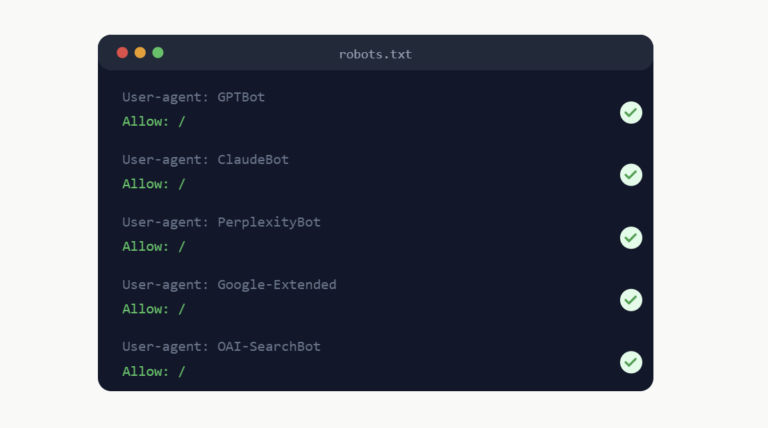
AI systems, like traditional search engines, can only work with content they can access. This starts with robots.txt: make sure important pages aren’t accidentally blocked, and confirm that relevant crawlers can reach the site. For Google’s generative AI features specifically, a page needs to meet Google’s standard Search technical requirements and be indexed and eligible to show with a snippet, since generative AI features draw from the same Search index as regular results.
For AI search products outside Google, crawler access is managed separately by each provider. OpenAI, for example, documents a specific crawler called OAI-SearchBot used to surface websites in ChatGPT’s search features; OpenAI’s publisher guidance notes that any public website can potentially appear in ChatGPT search results, and that sites should avoid blocking OAI-SearchBot if they want to be discoverable and cited there. This is a separate setting from GPTBot, which OpenAI uses for model training rather than search visibility. For a full breakdown of which crawlers matter and how to configure access for each one, see Verixo’s AI crawlability guide.
Security tools and CDNs can also unintentionally block legitimate crawlers through overly aggressive bot protection. It’s worth periodically checking server logs or crawler-testing tools to confirm important AI crawlers aren’t being blocked by infrastructure rather than a deliberate robots.txt rule.
2. Build Clear Brand and Entity Signals
Consistency helps both classic SEO and AI systems correctly identify who is publishing content. This includes clear Organization information on the site, a genuine About page, named authors or founders where relevant, and consistent business naming across the website and external profiles (directories, review platforms, social profiles). Structured data that accurately describes the organization can support this, though it is a supporting signal rather than a requirement.
3. Publish Non-Commodity Content
Google’s guidance draws a specific distinction between “commodity content,” material that could have been written by anyone and adds little beyond common knowledge, and “non-commodity content,” which reflects a unique point of view, direct experience, or original insight. Google states this factor will likely influence a site’s presence in generative AI search more than any other single suggestion in its guide.
In practice, this means favoring original case studies, direct professional experience, unique data, and genuine expert analysis over generic, easily-reproduced summaries. Businesses considering AI-assisted content creation should ensure that output still meets Google’s standard content-quality and spam policies; the tool used to draft something matters far less than whether the final result is genuinely useful.
4. Answer Important Questions Clearly
Structuring content so it directly answers real questions, early and clearly, supports both traditional featured-snippet-style visibility and AI summarization. This is the practical core of AEO: organized sections, direct definitions, clear comparisons, and content that doesn’t bury its main point.
5. Build Genuine Authority
Backlinks and brand mentions remain meaningful signals of trust for both classic SEO and AI-informed visibility. The operative word is genuine: Google specifically warns against pursuing inauthentic mentions purely to influence AI systems, noting this isn’t effective and is evaluated by the same quality and spam systems as any other manipulation attempt. Real editorial link building, earned through relevant, high-quality placements, remains one of the more durable ways to build authority that supports both.
6. Strengthen Technical SEO
A technically healthy site (fast, mobile-friendly, free of major crawl errors, with reduced duplicate content) remains foundational. None of the generative AI-specific guidance changes this; if anything, it reinforces that technical health is a prerequisite rather than an optional extra. Verixo’s technical SEO services cover this groundwork directly.
7. Measure Search and AI Referral Performance
Google Search Console now includes a Generative AI performance report specifically for tracking visibility within AI Overviews and AI Mode. Beyond that, tracking referral traffic from AI platforms, monitoring branded search queries, and watching conversion trends all provide useful (if imperfect) signals. It’s worth being honest that AI citation measurement across platforms like ChatGPT and Perplexity is still far less standardized than traditional rank tracking, and third-party tools claiming precise, guaranteed visibility metrics should be evaluated carefully.
Do You Need a Separate GEO Strategy?
Not necessarily, and the answer genuinely depends on where a business is starting from.
A business with weak technical SEO, thin content, or unresolved crawlability issues should fix those foundational problems first. Layering AI-specific tactics on top of a broken foundation rarely produces meaningful results, since the same underlying index and quality systems inform both classic rankings and AI features.
A business with a mature, technically sound SEO program has more room to extend its existing strategy toward AI discoverability specifically: sharpening entity clarity, expanding genuinely citation-worthy content, improving direct-answer formatting, and monitoring AI referral traffic alongside existing SEO metrics. For this group, “GEO” is less a separate strategy and more a refined lens applied to work that’s already underway.
Want a clear read on which category your site falls into? A SEO audit identifies whether foundational issues need attention before AI-specific optimization makes sense.
SEO vs GEO: What Should You Prioritize?
| Situation | Priority |
|---|---|
| New website | Foundational SEO first: crawlability, indexing, core content. AI visibility follows naturally once the basics are solid. |
| Technically unhealthy website | Fix technical issues before anything else. No AI-specific tactic compensates for a site Google can’t properly crawl or index. |
| Established SEO website | Extend existing strategy with entity clarity, citation-worthy content, and AI referral tracking alongside current SEO work. |
| Strong brand, weak AI visibility | Audit entity signals, consistency of brand information, and content structure; this is often a clarity problem, not a content-volume problem. |
| Local business | Prioritize accurate business details, Google Business Profile completeness, and location-specific content; Google’s generative features draw local information from the same sources as standard local results. |
| E-commerce site | Ensure product data feeds and structured product information are accurate and complete, since generative shopping features draw on that same data. |
| B2B/SaaS company | Focus on original expertise and non-commodity content (real product knowledge, direct case studies) over generic category content that’s easy for AI systems to source elsewhere. |
A Practical SEO + GEO Framework
- Fix technical accessibility. Confirm the site is fully crawlable and indexable, robots.txt isn’t blocking important content or relevant AI crawlers, and Core Web Vitals are healthy.
- Map search and buyer questions. Identify the real questions an audience asks at each stage of their research, not just isolated keywords.
- Build authoritative topic coverage. Develop genuinely useful, non-commodity content that covers a subject thoroughly, reflecting real expertise rather than recycled summaries.
- Strengthen entity and external authority. Keep brand information consistent everywhere, build genuine backlinks and mentions, and maintain a clear About/author presence.
- Measure traffic, visibility, and conversions. Track classic SEO metrics alongside Search Console’s Generative AI performance report and referral data from AI platforms, treating the latter as directional rather than precise.
Common GEO Myths
Myth: SEO is dead because of AI.
Incorrect. Google’s own guidance states generative AI features are built on the same core ranking and quality systems as standard search. A page that doesn’t rank or index well in traditional SEO terms has little basis for appearing in AI-generated answers either.
Myth: There is a special GEO schema.
Incorrect. Google has stated directly that there is no special schema.org markup required for generative AI search, and that structured data, while useful for standard rich results, isn’t required specifically for AI features.
Myth: Publishing hundreds of AI-generated articles will improve AI visibility.
Incorrect, and potentially counterproductive. Google explicitly warns that creating large volumes of content primarily to cover every possible query variation, rather than serving genuine reader needs, falls under its scaled content abuse policies. Volume doesn’t substitute for quality or genuine usefulness.
Myth: An llms.txt file guarantees AI visibility.
Incorrect for Google Search specifically. Google’s guidance states plainly that it does not use llms.txt or similar special files, and that creating one will neither help nor hurt visibility in Google Search. Some other AI tools may reference such files differently, but no major platform has documented it as something that guarantees inclusion or citation.
Myth: You can guarantee ChatGPT citations.
Incorrect. OpenAI’s own documentation describes steps that help make a site eligible for search visibility and citation, such as allowing OAI-SearchBot, but does not promise that following these steps results in a specific citation or placement. No credible SEO or GEO provider, including Verixo SEO, can guarantee placement or citation in ChatGPT, Google AI Overviews, Google AI Mode, Gemini, Perplexity, or Copilot.
GEO vs SEO FAQs
What is GEO in SEO?
GEO (Generative Engine Optimization) refers to the subset of SEO work focused specifically on improving visibility within AI-generated search answers, such as AI Overviews or ChatGPT search results. It is a focus area within the broader discipline of SEO rather than a separate, competing practice.
Is GEO replacing SEO?
No. Google’s official guidance states that optimizing for generative AI search is still SEO, built on the same core ranking and quality systems as standard search. Foundational SEO work remains necessary for AI visibility, not optional.
What is the difference between GEO and AEO?
GEO refers broadly to visibility within generative AI search experiences. AEO (Answer Engine Optimization) refers more specifically to structuring content to directly and clearly answer questions. AEO is largely a content-formatting practice that supports GEO goals, and both overlap heavily with standard SEO.
Does ChatGPT use SEO?
ChatGPT’s search feature relies on its own crawler, OAI-SearchBot, to discover and surface web content, which is a separate system from Google’s search index. Many of the same underlying principles apply, such as crawlability, clear content, and genuine authority, but ChatGPT visibility depends on OpenAI’s specific crawler access and citation systems rather than Google’s ranking algorithm.
Can SEO help a website appear in ChatGPT Search?
Yes, in the sense that solid technical SEO (crawlable, well-structured, genuinely useful content) creates the conditions OpenAI’s own guidance describes as necessary for a site to be discoverable and citable. However, appearing in ChatGPT search also requires not blocking OAI-SearchBot specifically, which is a separate technical step from standard SEO.
Does schema help GEO?
Structured data can help search engines and AI systems understand a page’s content and entity information more precisely, and it remains useful for standard SEO rich results. However, Google has stated explicitly that no special or additional schema is required specifically for generative AI visibility.
Do backlinks help AI visibility?
Genuine backlinks and brand mentions contribute to the overall authority and trust signals that inform both classic rankings and AI-generated answers. Artificially manufactured or inauthentic mentions specifically intended to influence AI systems are explicitly discouraged by Google and are evaluated under the same quality and spam systems as any other manipulation attempt.
How do you measure GEO?
Measurement tools are still maturing. Google Search Console includes a Generative AI performance report covering AI Overviews and AI Mode visibility. Beyond Google, tracking referral traffic from AI platforms and monitoring branded search volume are common but imprecise proxies, since most AI platforms don’t yet offer the same granular reporting available for traditional search.
Is GEO worth investing in?
For businesses with a solid SEO foundation already in place, extending that work to address entity clarity, citation-worthy content, and AI referral tracking is a reasonable investment as AI search usage grows. For businesses without that foundation, resources are generally better spent fixing core SEO issues first, since AI visibility depends on the same underlying systems.
Final Thoughts: SEO and GEO Work Better Together
SEO provides the foundation: crawlability, technical health, genuine content quality, and authority built over time. GEO extends that foundation’s visibility into a newer layer of discovery, generative and answer-driven search experiences, rather than replacing what came before it.
The businesses navigating this well in 2026 aren’t choosing between SEO and GEO. They’re treating GEO as a natural extension of solid SEO fundamentals, applied with an awareness of how AI systems specifically retrieve, synthesize, and present information.
Want to Know How Visible Your Brand Is in AI Search?
Verixo SEO can review your technical SEO, content, entity signals, authority, and AI search opportunities to identify where your brand should focus next.