7 SEO Myths in 2026 That Are Still Wasting Budget
SEO advice spreads fast, and a lot of it never expires the way it should. Tactics that stopped working years ago still show up in guides, forums, and pitches from vendors who either don’t know better or don’t want you to. Some of it was accurate once and simply hasn’t been updated. Some of it was never true at all.
Here are seven myths that still cost businesses real money in 2026, and what actually works in their place.
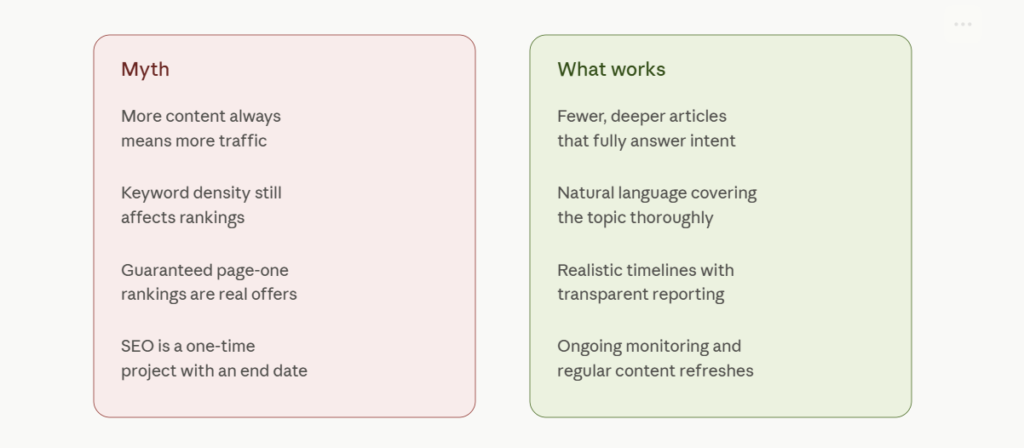
Myth 1: More content always means more traffic
Publishing volume alone doesn’t move rankings anymore. Google’s helpful content systems specifically look for thin, repetitive, or low-value pages, and a site full of them can drag down the whole domain’s quality signal, not just the weak pages themselves.
What actually works: Fewer, deeper articles that fully answer a question outperform a high volume of shallow posts. A content refresh on existing pages often produces better results than publishing something new.
Myth 2: Keyword density is still a ranking factor
Repeating a target keyword a set number of times per page hasn’t mattered for a long time. Search engines understand topics and synonyms well enough that forced repetition now reads as a red flag, not a signal.
What actually works: Write naturally, cover the topic thoroughly, and use related terms the way a real expert would. Keyword stuffing gets flagged by both Google’s systems and, increasingly, by AI content detectors reviewers use to check quality.
Myth 3: Domain Rating is the only thing that matters for a backlink
A high Domain Rating number looks impressive in a report, but a link from an irrelevant, high-DR site often does less than a link from a smaller, genuinely relevant one. Relevance and real traffic matter as much as the number.
What actually works: Vet links on relevance, real organic traffic, and topical fit, not DR alone. A backlink strategy built purely around hitting a DR threshold tends to attract low-quality, off-topic placements.
Myth 4: Guaranteed first-page rankings are a real offer
No agency controls Google’s algorithm. Anyone promising a guaranteed page-one ranking within a fixed short timeframe, especially for a competitive keyword, is either overselling or planning to use tactics that risk a penalty.
What actually works: A realistic timeline based on your site’s current authority and competition, with transparent reporting on real progress, not a betting-style promise.
Myth 5: AI-written content always gets penalized
Google has clarified repeatedly that content isn’t penalized for being AI-assisted. It’s penalized for being low quality, unhelpful, or created purely to manipulate rankings, regardless of whether a human or an AI wrote it.
What actually works: AI-assisted content that’s fact-checked, edited for accuracy, and genuinely useful performs fine. The quality bar is what matters, not the tool used to hit a first draft.
Myth 6: Meta keywords still matter
The meta keywords tag has been ignored by Google for well over a decade. Some older SEO checklists and plugins still list it as a task, which wastes time that could go toward things that actually move rankings.
What actually works: Focus that time on meta titles and descriptions instead. They don’t directly affect rankings either, but they strongly affect click-through rate, which does influence performance over time.
Myth 7: SEO is a one-time project
A common pitch treats SEO as a project with an end date. Fix the technical issues, publish some content, done. In reality, competitors keep publishing, algorithms keep updating, and content that ranked well two years ago often needs a refresh to hold its position.
What actually works: SEO performs best as an ongoing process, with regular content updates, technical monitoring, and adjustment as the search landscape shifts, including the growing role of AI search tools.
Why These Myths Persist
Most of these myths were true at some point, or close to true. SEO advice from 2015 wasn’t wrong for 2015. The problem is that search has changed faster than a lot of the advice circulating online has been updated, and outdated tactics are easier to package into a simple checklist than the more nuanced reality.
Vendors selling backlink packages, content mills, and quick-fix services also have an incentive to keep some of these myths alive, because they’re easier and cheaper to deliver than real strategy.
A Quick Way to Spot Outdated Advice
Before following any SEO tip in 2026, ask:
- Does this advice cite a specific Google statement or documented ranking factor, or is it just “common knowledge”?
- Does it promise a guarantee no algorithm could actually guarantee?
- Is it focused on tricking a system, or genuinely helping a real reader?
- Would this same tactic have worked five years ago, and has anything changed since?
If a piece of advice fails more than one of these checks, treat it with real skepticism before spending budget on it.
The Bottom Line
SEO in 2026 rewards the same underlying thing it always has at its best: genuinely useful content, a technically sound site, and real authority built over time. The myths that persist are almost always shortcuts that promised to skip that work. They didn’t work then either. They just took longer to get caught.
Spend the budget on what’s actually measurable, transparent, and grounded in how search engines and AI systems work today, not on tactics that stopped working years ago.