How Much Do Backlinks Cost in 2026?
There’s no single, universal price for a backlink. Current market research on guest posts and niche placements shows typical costs roughly between $100 and $500 per link before agency markup, with vendor-managed or premium placements often running $700 to $1,500 or more. Digital PR campaigns and high-authority editorial placements can cost significantly more per link. Simple niche outreach, editorial placements, digital PR, and full agency-managed campaigns all use different pricing models entirely. Price alone should never be used to judge backlink quality.
Ask three different providers what a “high-quality backlink” costs and you’ll likely get three very different numbers, sometimes an order of magnitude apart. That’s not necessarily a sign that someone is lying. A backlink isn’t a standardized product the way a barrel of oil or a share of stock is. Two links both described as “high quality” can differ enormously in relevance, editorial effort, audience, and long-term value, and that variation is exactly what drives the wide pricing spread.
This guide breaks down what actually drives backlink pricing, what current market research shows, and how to evaluate whether a quoted price reflects real value or just a number designed to look impressive.
How Much Does a Backlink Cost in 2026?
Based on current, published market research (cited below, with sources and important caveats), here’s a general picture of what different link types tend to cost. These are market observations from third-party industry studies and vendor data, not fixed or guaranteed prices, and individual publisher or vendor pricing can vary substantially from any of these figures.
| Link Type | Typical Pricing Model | What You’re Paying For | Important Caveat |
|---|---|---|---|
| Niche outreach / link insertion | Roughly $150–$400 per placement in most published studies | A link added into existing, relevant content | Insertions into already-published articles are less common at higher-quality sites |
| Guest contribution (direct from publisher) | Roughly $100–$500, with premium sites reaching well beyond this | The placement itself, sometimes writing support | Prices vary heavily by Domain Rating, traffic, and niche |
| Guest post (vendor/agency-managed) | Often $700–$1,500+ after markup, per multiple published studies | Outreach, writing, publisher relationship, placement, reporting | Markup reflects service layers, not just the raw link |
| Digital PR campaign | Published estimates range widely, roughly $300–$1,500+ per resulting link depending on the source | Research, content creation, journalist outreach, coverage across multiple outlets | Per-link cost is often an average across a campaign, not a fixed quote for one link |
| Expert contribution / commentary | Often bundled into PR or outreach retainers rather than priced individually | Time spent building relationships and providing quotable expertise | Rarely sold as a standalone, fixed-price product |
| Resource-page outreach | Frequently lower cost or included in broader campaigns | Outreach effort to get an existing resource added to a relevant list | Placement isn’t guaranteed even when outreach is paid for |
| Agency-managed link building (retainer) | Monthly retainers vary enormously by scope and volume | Strategy, prospecting, outreach, content, quality control, and reporting combined | “Price per link” often understates what’s actually included |
Why Backlink Prices Vary So Much
A “backlink” is really shorthand for a wide range of very different things: a link squeezed into an old article on a low-traffic site, a fully commissioned guest article on a respected industry publication, a mention earned through original research covered by multiple journalists, or a directory listing with no editorial involvement at all. Calling all of these “a backlink” is technically accurate and practically misleading.
Consider a hypothetical example. Two vendors both quote a price for “a high-quality backlink” for a project management SaaS company. One is offering a placement on a general guest-post marketplace site with a high Domain Rating but almost no relevant traffic. The other is offering a placement on a smaller, genuinely read business publication with real project-management-adjacent content and an editorial team that reviews submissions. These aren’t the same product, even though both fit the same one-word description, and pricing them as if they were is where a lot of buyer confusion starts.
The 10 Biggest Factors That Affect Backlink Cost
1. Topical Relevance
A publication closely aligned with a business’s actual industry often carries more strategic value than an unrelated site with a higher authority metric, and pricing sometimes (though not always) reflects that. A SaaS company benefits more from a software or business publication than an unrelated general-interest site. A yoga studio benefits more from a wellness or fitness publication. A laser equipment manufacturer benefits more from a manufacturing or engineering trade publication. This doesn’t mean an unrelated link automatically causes harm, but relevance is a real driver of both value and, often, price.
2. Organic Traffic and Search Visibility
Real ranking keywords, genuine organic landing pages, visible traffic trends, and branded search volume all point to an actual audience rather than a domain that exists mainly to sell links. There’s no hard rule like “a site must have 10,000 monthly visits to be worth paying for.” A niche, lower-traffic publication can still be genuinely valuable if its smaller audience closely matches your target customer.
3. Editorial Standards
Publications with real editorial review, fact-checking, contributor guidelines, content requirements, and a genuine approval or rejection process often command higher prices, and that friction is frequently a positive quality signal rather than an obstacle. A site that will publish literally anything for a fee typically has neither the editorial cost structure nor the audience trust that justifies premium pricing.
4. Website Authority Metrics
Domain Rating (Ahrefs), Domain Authority (Moz), and Authority Score (Semrush) are third-party, proprietary metrics; Google does not use Ahrefs’ DR or Moz’s DA as a direct ranking factor. These metrics can help with initial screening, but they shouldn’t be treated as the sole basis for either quality judgment or pricing. For a deeper breakdown of how to evaluate a link opportunity beyond authority scores, see Verixo’s guide on evaluating backlink quality (recommended internal link once that guide is live at /what-makes-a-backlink-high-quality/).
5. Link Placement
A contextual link embedded in new or existing editorial content generally differs in price and value from an author-bio link, a resource-page listing, a directory entry, or a footer or sitewide placement. Pricing often varies by placement type, though no single placement type carries a guaranteed SEO value regardless of context.
6. Content Creation
A quoted “link price” frequently includes far more than the hyperlink itself: research, writing, editing, sourcing of graphics or data, subject-matter expertise, revisions, and formatting to a publisher’s specific standards. A $400 guest post quote that includes a genuinely well-researched 1,500-word article is a different value proposition than a $400 quote for inserting a link into a sentence in an existing post.
7. Outreach Difficulty
Some placements require real, time-intensive work: prospecting relevant sites, finding the right contact, personalizing pitches, negotiating terms, following up, and building an actual relationship with an editor or publisher over time. This labor is a direct input into agency and vendor pricing, separate from the raw cost of the link itself.
8. Industry
Certain categories, often cited as including finance, legal services, SaaS, health, insurance, and cybersecurity, tend to see higher link-building costs, generally because competition for visibility is fiercer and publishers in these spaces often apply stricter editorial standards. Exact premium percentages vary too much by source to state a reliable figure here.
9. Geography and Audience
Publisher economics and audience value differ across regions. Pricing and available inventory for US, UK, Australian, and broader European audiences often differ from smaller or more localized or niche markets, partly reflecting differences in advertiser demand and publisher operating costs in each region.
10. Campaign Management
Agency or service pricing frequently bundles in competitor backlink analysis, strategy development, prospect qualification, outreach execution, negotiation, content production, quality control, link tracking, and reporting. A “price per link” figure can understate the actual value delivered when it’s really covering an entire managed process rather than a single isolated placement.
Backlink Pricing Models Explained
Price Per Placement
A fixed fee for one specific link on one specific page or site. Straightforward to understand and compare, but doesn’t account for ongoing strategy, prospecting, or campaign coordination.
Monthly Link Building Retainer
An ongoing monthly fee covering continuous outreach, placement, and reporting. Useful for sustained, long-term campaigns, though the number of links delivered per month can vary based on available quality opportunities that month.
Digital PR Campaign Pricing
Typically a project fee covering research, asset creation, and journalist outreach, with the resulting number and quality of links varying by campaign performance rather than being guaranteed upfront. Cost per resulting link is often calculated after the fact as an average across the whole campaign.
Outreach + Placement Fees
Some providers separate the cost of outreach labor from any publisher fee charged by the site itself, giving more visibility into where the money actually goes, though this model requires more buyer engagement to evaluate properly.
Project-Based Link Building
A defined scope (a set number of placements, a specific target page, a fixed timeframe) priced as a single project rather than an ongoing retainer or per-link fee.
Performance or Deliverable-Based Campaigns
Pricing tied to specific deliverables (a confirmed number of live, qualifying placements) rather than hours worked or raw outreach volume. Worth distinguishing clearly from “pay only for ranking results” offers, which raise different concerns covered later in this guide.
No single model here is universally superior. The right choice depends on budget predictability needs, campaign complexity, and how much day-to-day involvement a business wants in the process.
Why Cheap Backlinks Can Become Expensive
Extremely low-cost, high-volume link offers (“500 backlinks for $50”) deserve real scrutiny, not because cheap automatically means spam, but because of how those links are typically created at that price point. Warning signs worth watching for: placements on completely irrelevant websites, automated or templated placements with no human review, mass-produced, low-effort content, sites showing signs of fake or purchased traffic, expired-domain networks repurposed to sell links, private blog networks, pages with an excessive number of outgoing links, heavily repeated exact-match anchor text, and sites that publish content across every conceivable niche simultaneously with no coherent editorial focus.
The issue isn’t the low price by itself. It’s that achieving that price point at scale usually requires cutting corners in ways that show up in exactly these patterns, and links built this way can end up costing more in the long run: wasted budget, brand association with low-quality sites, and time spent later cleaning up or replacing an unnatural link profile.
Are Expensive Backlinks Always Better?
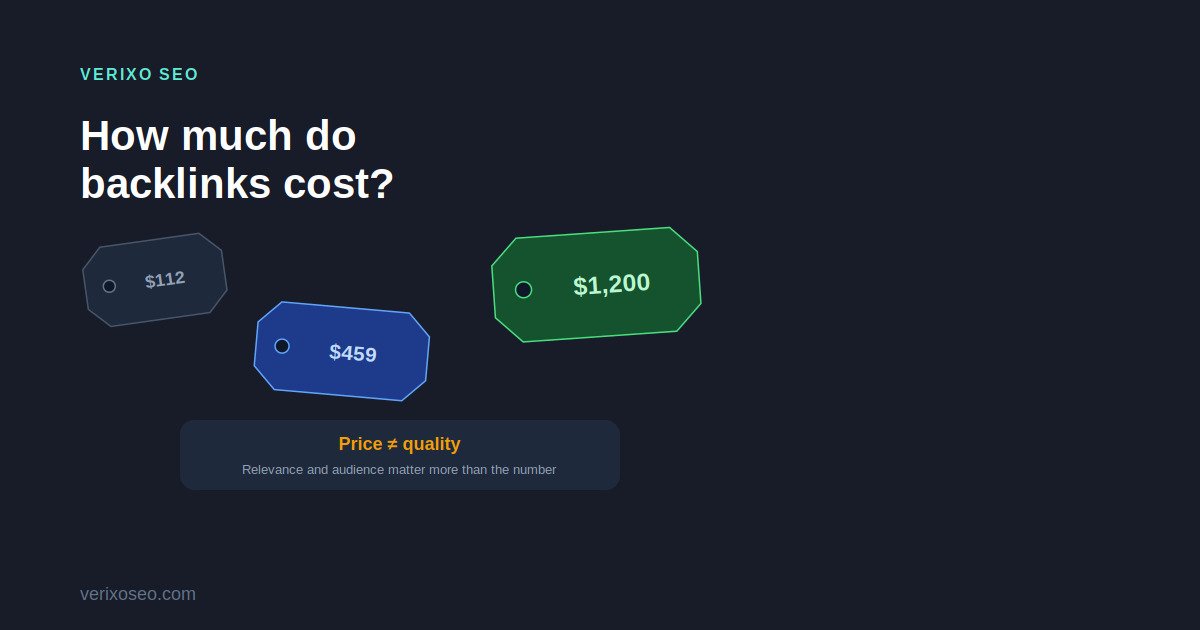
No. A higher price can genuinely reflect a stronger publication, more editorial effort, more competitive demand, or a more valuable audience. But it can also reflect reseller markup layered on top of a modest underlying link, inflated Domain Rating with little real traffic behind it, premium pricing simply because a publisher name is recognizable, or artificial scarcity used as a sales tactic.
Consider a hypothetical comparison. Publisher A has a DR of 80, charges $1,200 per placement, and shows almost no relevant organic traffic; it operates as a general guest-post site accepting content across unrelated industries. Publisher B has a DR of 52, charges $400, has a real and topically relevant audience, ranks for genuine industry terms, and applies actual editorial review before accepting content. In this hypothetical, Publisher B likely represents the stronger opportunity despite the significantly lower price and lower DR, because the underlying value drivers, relevance, real audience, and editorial credibility, favor it clearly.
Backlink Cost vs Backlink Quality
| Factor | Why It Matters | Should It Affect Price? |
|---|---|---|
| Relevance | Determines whether the link makes commercial and editorial sense | Often, but not always, reflected in pricing |
| Organic traffic | Signals a real audience versus a link-selling shell | Often reflected, though not always accurately |
| DR/DA | Rough third-party screening tool, not a Google metric | Frequently drives pricing, sometimes more than it should |
| Editorial quality | Indicates real review, standards, and credibility | Should influence price when standards are genuine |
| Audience | Determines referral and brand-exposure value | Relevant but harder to price precisely |
| Placement | In-content editorial links differ from footer/directory links | Often reflected in different pricing tiers |
| Anchor text | Natural anchors signal editorial control; forced anchors signal manipulation | Rarely priced directly, but affects real value |
| Publisher credibility | Separates real publications from marketplaces | Should influence price, doesn’t always |
| Content quality | Determines whether the page itself has lasting value | Frequently underweighted relative to DR |
| Referral opportunity | Real traffic value independent of any SEO benefit | Rarely priced explicitly, but a genuine value driver |
How Much Should You Spend on Link Building?
There’s no single correct monthly figure. A reasonable budget depends on business size, competitive intensity in your market, your site’s current authority relative to competitors, the quality of content you already have to support new links, your specific target market, broader marketing goals, and which pricing model and campaign type you’re pursuing.
A few illustrative scenarios, without guaranteed outcomes attached to any of them: a new local business might prioritize a small number of highly relevant, locally focused placements over volume. An established SaaS company competing in a crowded space might need a sustained, larger monthly investment across guest content and digital PR. An e-commerce brand might focus spend on category and product-page-relevant placements tied to a broader content strategy. A competitive B2B company might allocate a larger share of budget toward digital PR and original research, given how much publisher relevance and audience quality matter in that space.
Backlink Pricing vs Monthly Backlink Packages
It’s worth separating two different questions. An individual backlink quote answers: what does this one placement cost? A backlink package answers a broader question: what strategy, placement volume, publisher qualification process, outreach effort, and reporting are actually included for a given monthly investment?
This article focuses on the first question, backlink cost and pricing education in general. For a breakdown of Verixo’s actual backlink packages and pricing, including tiers, what’s included, and transparent per-package details, that page is the right place to look.
What Should Be Included in Link Building Pricing?
Before comparing quotes, it’s worth confirming exactly what’s covered. A reasonably complete link-building service typically addresses:
- Strategy and target-page planning
- Competitor backlink analysis
- Prospect research
- Publisher qualification and vetting
- Outreach execution
- Negotiation
- Content creation
- Editorial revisions
- Actual placement
- Live URL reporting
- Anchor text review
- Quality control
- Ongoing monitoring
Two quotes that look wildly different on price sometimes cover very different scopes of this list. Ask directly what’s included before assuming a lower number represents a better deal.
Questions to Ask Before Paying for a Backlink
- Is the site genuinely relevant to my industry?
- Does it show real organic search visibility?
- Where does its traffic actually come from?
- Can I review the specific publisher before approving the placement?
- Is this new content being written, or an insertion into an existing page?
- Who writes the content?
- Is the content editorially reviewed before publishing?
- If compensation is involved, how will the link be qualified (for example, with rel=”sponsored”)?
- What anchor text will be used?
- Is publication guaranteed, or subject to genuine editorial approval?
- What happens if the article or link is later removed?
- Is the publisher part of a private, interconnected network of sites?
- Can I reject sites that don’t fit my business?
Asking these questions upfront, rather than after payment, is one of the more effective ways to avoid a wasted budget.
Publisher Fees vs Link Building Agency Fees
A publisher fee relates to the actual placement itself, whether framed as a sponsored, editorial, or otherwise compensated arrangement with the site hosting the link. An agency fee, by contrast, can include strategy development, publisher qualification, outreach labor, ongoing communication, content writing, negotiation, reporting, and account management layered on top of (or sometimes instead of) any direct publisher fee.
Comparing providers purely by “cost per backlink” can be misleading as a result, since one number might represent a bare publisher fee and another might represent a fully managed service covering significant additional work. Understanding which parts of the process a quote actually covers is more useful than comparing headline numbers alone.
Should You Buy Backlinks?
This deserves a careful, non-simplistic answer rather than a flat yes or no.
Businesses legitimately pay for advertising, sponsorships, partnerships, PR services, content distribution, and various publisher opportunities across the web, and there’s nothing inherently wrong with that. The distinction that matters, according to Google’s spam policies, is between compensated arrangements handled transparently and appropriately qualified, and links created primarily to manipulate search rankings, which can violate those policies regardless of how the transaction is described.
Where compensation is involved, Google’s guidance on qualifying outbound links points to attributes like rel=”sponsored” (or, where appropriate, rel=”nofollow”) as the mechanism for properly disclosing that relationship. Purchasing a link without this kind of qualification, when compensation was clearly involved, carries real policy risk, independent of how well the site otherwise performs on relevance or traffic.
Sustainable authority building generally leans more heavily on digital PR, genuine editorial outreach, publishing useful resources and original research, building real partnerships, and earning genuine mentions from relevant publications, alongside any compensated placements that are handled transparently.
Paid Links vs Editorial Links vs Digital PR
| Type | How It Happens | Level of Editorial Control | Primary Value | SEO/Policy Consideration |
|---|---|---|---|---|
| Paid placement | Direct payment for inclusion of content and a link | Publisher-controlled but transaction-driven | Placement certainty | Should be qualified (e.g., rel=”sponsored”) where compensation exists |
| Editorial mention | Publisher independently references your business | Fully publisher-controlled | Strong credibility and relevance signal | Generally low policy risk |
| Guest contribution | Contributor pitches and writes content for a publisher | Shared, subject to publisher’s editorial standards | Thought leadership, relationship building | Risk depends heavily on publisher quality and standards |
| Digital PR | Original research, data, or newsworthy angle pitched to journalists | Journalist/publisher-controlled | High-authority coverage, brand exposure | Generally low policy risk when coverage is earned, not purchased |
| Resource citation | Existing useful resource gets referenced or linked to | Publisher-controlled | Long-term, durable relevance signal | Low policy risk |
What Is a Fair Price for a Backlink?
“Fair” depends entirely on what’s actually included and what’s actually being evaluated, not on a fixed number. A useful set of questions: Is the publisher a real, credible organization? Is the audience genuinely relevant to your business? Is the content itself useful, independent of the link? Is there real editorial oversight? Is the pricing transparent about what’s included? Would the link make sense to a reader even if SEO didn’t exist? Would your brand value this placement even if it carried zero ranking benefit?
A simple guiding principle worth keeping in mind: if the only reason you want a specific link is its DR score, that’s a signal to reconsider the opportunity rather than proceed on price alone.
How Verixo Evaluates Backlink Opportunities
Rather than qualifying opportunities on price or Domain Rating alone, Verixo’s evaluation approach considers relevance, organic visibility, publisher credibility, editorial quality, outbound-link behavior on the prospective site, page-level content quality, audience relevance, anchor text and placement context, broader search visibility, and genuine business value independent of any SEO benefit. This evaluation process underpins Verixo’s editorial link building services, rather than any proprietary scoring technology.
The Real Cost of a Bad Backlink Campaign
A poorly evaluated link-building campaign carries costs beyond the invoice: wasted budget on placements that never deliver relevance or traffic, poor brand association from appearing alongside unrelated or low-quality content, time spent later identifying and replacing weak links, low or nonexistent referral value, an unnaturally aggressive anchor text profile that draws unwanted scrutiny, potential exposure to search-policy risk depending on how links were acquired, and reporting that looks impressive on paper (link counts, DR figures) while generating little actual business value.
None of this requires alarm; it’s simply the practical downside of prioritizing volume or a headline metric over genuine evaluation.
How to Compare Backlink Vendors
| Question | Strong Provider | Warning Sign |
|---|---|---|
| Can you preview sites before payment? | Yes, with transparency | No, sites revealed only after payment |
| How are sites vetted? | Relevance, traffic, and editorial review | DR threshold only |
| Is traffic checked? | Yes, with real data reviewed | Not mentioned or dismissed as unimportant |
| Is relevance checked? | Yes, explicitly part of the process | Not addressed |
| How is anchor text selected? | Natural, varied, client-reviewed | Fixed exact-match anchors required |
| Is content reviewed? | Yes, quality-checked before publishing | No visibility into what gets published |
| Are results guaranteed? | No specific ranking guarantees offered | “Guaranteed #1 rankings” or similar promises |
| Are PBNs used? | Explicitly avoided | Vague or evasive answers |
| Are placements transparent? | Live URLs shared and verifiable | Only summary reports, no verifiable URLs |
| Is reporting provided? | Clear, detailed, ongoing | Minimal or delayed reporting |
A provider promising guaranteed rankings or a specific Google position should be treated as a significant warning sign; no legitimate provider controls Google’s algorithm closely enough to make that promise honestly.
Backlink Pricing Red Flags
Guaranteed rankings or a guaranteed Google position, thousands of links offered for an implausibly low total price, no visibility into which specific sites you’re paying for, qualification based on DR alone with no relevance or traffic review, exact-match anchor text required as a condition of the deal, inventory dominated by sites showing PBN characteristics, evidence of fake or purchased traffic, no reporting or verification of live placements, and a publisher roster made up of sites publishing unrelated mass content across every niche.
No single one of these signals proves manipulation on its own. The pattern across several of them together is what generally distinguishes a legitimate provider from a risky one.
How to Calculate Link Building ROI
A practical framework starts with tallying the real investment: agency or outreach fees, content production costs, any publisher or PR fees, and internal staff time spent managing the process. On the return side, relevant metrics include organic traffic growth, ranking movement on target pages, growth in referring domains, assisted conversions, direct referral traffic and its quality, resulting leads, attributable revenue where trackable, brand search volume growth, and overall authority trend over time.
It’s worth being honest that attribution here is rarely clean. SEO results, including from link building, typically reflect multiple factors working together (content quality, technical health, existing authority, competitive shifts) rather than any single backlink producing a clearly isolated, attributable outcome.
How Many Backlinks Should You Buy Per Month?
There’s no universally correct number, and treating link acquisition as a fixed monthly quota risks prioritizing volume over quality. The right pace depends on how many genuinely relevant, high-quality opportunities actually exist for your niche in a given period, your competitive landscape, your broader content strategy, the current state of your existing backlink profile, your business size and budget, and how outreach and PR efforts are actually performing month to month.
Quality shouldn’t be sacrificed simply to hit an arbitrary monthly link count. A slower pace of genuinely strong placements is a more defensible strategy than a fixed quota filled with mediocre ones.
Common Backlink Pricing Myths
Myth: A $1,000 backlink must be better than a $200 backlink.
Not necessarily. Price can reflect genuine value, but it can also reflect markup, inflated authority metrics, or brand-name pricing unrelated to real relevance or traffic.
Myth: Higher DR means higher fair price.
Not automatically. DR is a third-party metric that doesn’t account for relevance, real traffic, or editorial quality, all of which affect genuine value independent of DR.
Myth: Every dofollow backlink is worth paying for.
No. A standard link from an irrelevant or low-quality source provides limited value regardless of its link attribute status.
Myth: More expensive links guarantee stronger rankings.
No link, regardless of price, guarantees a specific ranking outcome.
Myth: Cheap backlinks are always spam.
Not automatically. Price alone doesn’t determine quality; a modestly priced, genuinely relevant, well-edited placement can be a strong opportunity.
Myth: Nofollow links have no value.
Incorrect. Nofollow and sponsored-tagged links can still deliver real referral traffic and brand exposure, independent of any direct ranking signal.
Myth: Backlink pricing can be standardized across every industry.
No. Relevance, competition, and publisher economics vary significantly by industry and region, making a single standard price impossible.
Myth: Buying a link guarantees ranking improvement.
No individual link purchase guarantees a specific ranking outcome; rankings depend on many factors working together.
Backlink Cost FAQs
How much does a backlink cost?
There’s no universal price. Published market research generally shows guest posts and niche placements in the roughly $100–$500 range before markup, with vendor-managed and premium placements often reaching $700–$1,500 or more, though individual pricing varies substantially.
Why are backlinks expensive?
Cost often reflects real inputs: content creation, outreach labor, editorial standards at the publishing site, and the value of a genuinely relevant, high-traffic audience, not simply an arbitrary markup.
How much should I pay for a backlink?
There’s no fixed correct amount. A fair price depends on relevance, real traffic, editorial quality, placement context, and what’s actually included in the service, not on hitting a specific number.
Are cheap backlinks bad?
Not automatically. Low price alone doesn’t indicate spam, though extremely cheap, high-volume offers often correlate with the shortcuts (irrelevant sites, automation, PBNs) that do indicate real quality problems.
Are expensive backlinks better?
Not automatically. A high price can reflect genuine value or simply reseller markup and inflated authority metrics; evaluate the underlying opportunity directly rather than assuming price equals quality.
How much does link building cost per month?
This varies enormously by business size, competition, and campaign scope. There’s no single correct monthly figure that applies across all businesses.
How much does a guest post cost?
Published 2026 industry research shows a wide range, with multiple studies citing averages roughly between $150 and $460 before markup, and vendor-managed placements often costing more after service layers are added. Individual site pricing varies significantly.
Is buying backlinks legal?
Yes, purchasing advertising, sponsorships, or compensated content placements is a legal commercial activity in itself.
Is buying backlinks against Google guidelines?
It depends on execution. Links created primarily to manipulate rankings can violate Google’s spam policies, while properly qualified paid placements (using attributes like rel=”sponsored”) are treated differently under current guidance.
Are paid backlinks safe for SEO?
Safety depends on how the link is created and disclosed. Properly qualified, genuinely relevant placements carry lower risk than unqualified links acquired primarily to manipulate rankings.
How can I tell if a backlink is worth the price?
Evaluate relevance, real organic traffic, editorial standards, placement context, and whether you’d value the link even without any SEO benefit, rather than relying on price or DR alone.
Should I pay based on DR?
No. DR is a useful screening tool but shouldn’t be the primary basis for either quality assessment or pricing decisions.
How many backlinks do I need per month?
There’s no universal number. The right pace depends on available quality opportunities, competition, and your specific goals, not a fixed quota.
Final Thoughts: Buy Quality and Strategy, Not Just Links
Backlink cost is only one variable in a much larger decision. A genuinely useful evaluation weighs relevance, editorial standards, real audience, organic visibility, publisher credibility, placement context, business value independent of SEO, and policy risk together.
The cheapest possible campaign can waste money if it produces irrelevant, low-quality placements. The most expensive campaign can waste money too, if high prices simply reflect markup and inflated metrics rather than genuine value. Strong link building requires thoughtful, case-by-case selection rather than optimizing for either extreme.
Pricing Comparison Table
| Link Type | Reported Range (Before Markup) | Reported Range (After Markup/Vendor) | Primary Source(s) |
|---|---|---|---|
| Link insertion / niche edit | ~$179–$361 | ~$225–$400+ | BuzzStream 2026 update; Adsy 2026 (52,671 sites) |
| Guest post (direct) | ~$100–$459 average, up to $10,000+ for top-tier | N/A | BuzzStream; Adsy; LinkPublishers 2026 report; Serpzilla marketplace data |
| Guest post (vendor/agency-managed) | ~$364.76 baseline | ~$700–$1,459 average | BuzzStream 2026 update; Outreachz synthesis |
| Guest post (marketplace, high-volume) | Median ~$112, average ~$164 | N/A | PressWhizz analysis of 22,000+ marketplace placements |
| Digital PR (per resulting link) | Widely reported as ~$300–$750 in some studies, ~$1,250–$1,500 in others | N/A | Rankz 2026 comparison; BuzzStream 2026 update |
Important note on this data: These figures come from vendor blogs, marketplace self-reported data, and industry surveys, not from Google or any neutral, independently audited source. Different studies report meaningfully different averages (for example, guest post averages ranging from roughly $112 to $459 depending on the study and methodology), which itself illustrates this article’s core point: there is no single, standardized backlink price, and any specific quote should be evaluated on its own merits rather than benchmarked against one “official” number.