

Restaurant SEO in Bali: How to Get Found and Booked
Bali’s restaurant scene is saturated and highly seasonal. Tourists search on their phone minutes before deciding where to eat, and most of that search happens on Google Maps and Google Search, not Instagram. A restaurant that isn’t visible in that moment loses the booking to whoever is.
This is based on real work across a multi-brand hospitality group in Bali, spanning a restaurant, a spa, and villa rentals. The brand names are kept out of this for client confidentiality, but the strategy and lessons are real.
Why Restaurant SEO Works Differently in Bali
Three things make this market distinct from restaurant SEO elsewhere:
- The audience is almost entirely non-local. Tourists searching “best restaurant in Canggu” or “romantic dinner Ubud” have zero brand loyalty and zero prior knowledge of your business. Everything has to be won in that single search moment.
- Search behavior is heavily map-based. “Near me” and location-specific searches dominate, meaning Google Business Profile optimization often matters more than the website itself.
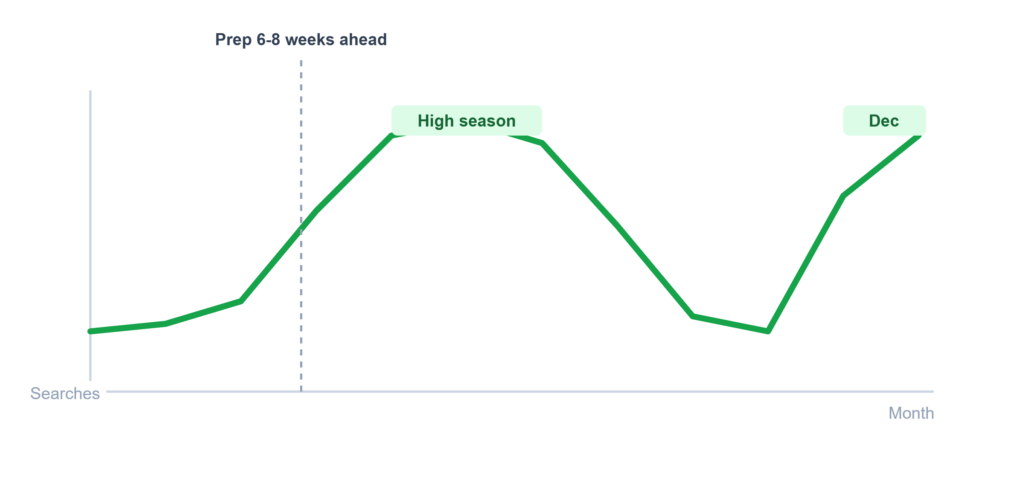
- Seasonality creates huge swings. High season (roughly June to September, and December) can bring 3-4x the search volume of low season, and a site needs to be positioned before the surge, not during it.
What Actually Moved the Needle
1. Google Business Profile as the primary asset, not an afterthought

For a tourist searching on their phone, the Google Business Profile card often gets more attention than the website. Getting this right meant:
- Complete, accurate categories (not just “Restaurant” but specific cuisine and dining style tags)
- Photos updated regularly, especially of dishes and ambiance, since these directly affect click-through from the map
- Consistent posting of updates, events, and specials through the GBP posts feature
- A steady, genuine review generation process, since review count and recency are strong local ranking factors
2. Location-specific landing pages, not one generic “About” page
A single restaurant with multiple concepts or a group with multiple properties needs a dedicated page per property and location, each targeting its specific area (Canggu, Seminyak, Ubud) rather than one page trying to rank for everything. Diluting relevance across a single page consistently underperforms dedicated, focused pages.
3. Menu content built for search, not just for the PDF
Many restaurants bury their menu in a PDF or image, which Google can’t read or rank. Converting menu content into actual on-page text, structured with dish names, descriptions, and pricing, made individual dishes and cuisine types searchable in a way a PDF never could be.
4. Review platform strategy across TripAdvisor and Google together
TripAdvisor still carries real weight for the tourist decision-making process in Bali specifically, even as Google Maps has grown. A strategy focused only on Google reviews and ignoring TripAdvisor misses a meaningful share of the research and booking journey.
5. Seasonal content planning ahead of peak periods
Publishing content and refreshing listings 6-8 weeks before high season, rather than during it, gave time for indexing and ranking to mature before the traffic surge hit. Reactive updates during peak season arrive too late to capture the early part of the search spike.
The Cross-Brand Advantage
Working across a restaurant, spa, and villa brand under one group revealed something specific to hospitality clusters: internal linking and cross-referral between properties (a villa page linking to the restaurant, the restaurant mentioning the spa) builds a stronger combined local footprint than each property optimizing in isolation. A visitor researching one property in the group often becomes a lead for another, and the SEO structure can be built to support that.
What Didn’t Work
Worth being honest about this too:
- Generic, un-localized content performed poorly. Content written for “how to find a good restaurant” without specific Bali/location context underperformed content anchored to specific areas and specific tourist search patterns.
- Over-reliance on Instagram for discovery left a gap. Instagram drives awareness and repeat visits from people who already know the brand, but it does very little for a first-time tourist actively searching Google in the moment of deciding where to eat tonight.
A Practical Starting Checklist for Bali Hospitality Businesses
 Google Business Profile fully completed, with accurate categories and regularly updated photos
- A dedicated landing page per location or property, not one generic page
- Menu content published as real text, not only as a PDF or image
- An active review generation process across both Google and TripAdvisor
- Content and listing updates scheduled 6-8 weeks ahead of each high season
- Cross-linking between properties if operating multiple brands or locations
The Bottom Line
Restaurant SEO in Bali isn’t about competing for a single broad keyword. It’s about being the most complete, most locally specific, most recently updated option the moment a tourist opens Google Maps and searches nearby. The businesses winning this aren’t necessarily the best restaurants. They’re the most visible ones at the exact moment someone is deciding where to eat.
[Note: specific traffic and booking figures from this engagement are available on request, kept out of this article to protect client confidentiality.]

Для эффективной работы важно учитывать признаки форумов для хрумера https://www.olx.ua/d/uk/obyavlenie/progon-hrumerom-dr-50-po-ahrefs-uvelichu-reyting-domena-IDXnHrG.html, чтобы не тратить ресурсы впустую.