On-Page SEO in 2026: It’s Not Just About Ranking Anymore
On-page SEO used to have one job: help a page rank. Title tags, headers, keyword placement, all pointed toward one outcome. Get to page one.
That job hasn’t gone away. But in 2026, on-page SEO has a second job that matters just as much: make sure your page can answer a question clearly enough that an AI tool will quote it.
The easiest, highest-return way to do that is one simple habit most service pages still skip. Every service page needs an FAQ section. Not a generic one. A real one, built around the actual questions your buyers ask before they hire you.
Why FAQs Do More Work Than People Think
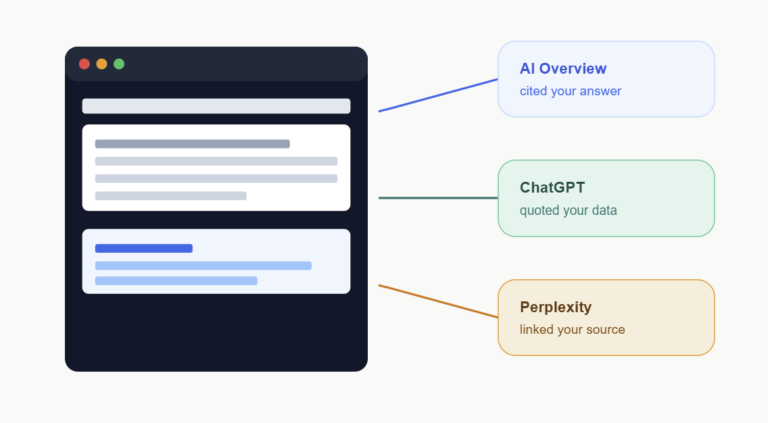
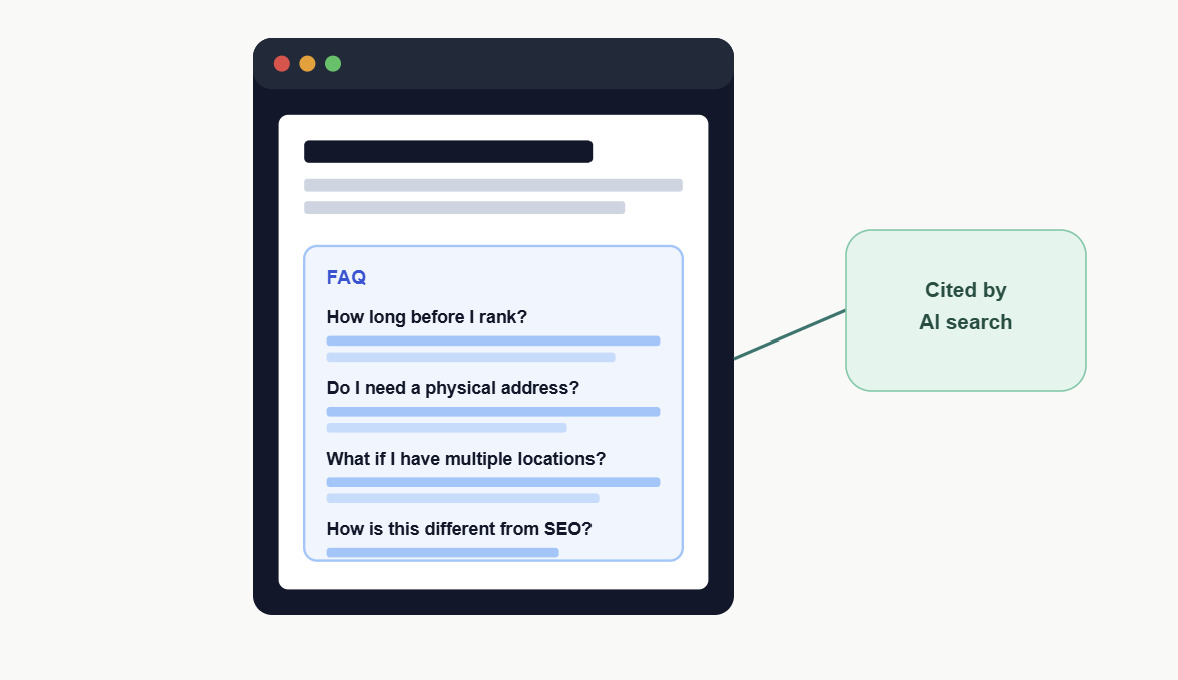
A well-written FAQ section is already shaped the exact way AI tools need content. A clear question, followed by a short direct answer. No fluff, no long paragraph to dig through. That’s the format ChatGPT, Perplexity, and Google’s AI Overview pull from most easily.
Most service pages describe what a service is. Very few directly answer the specific questions a buyer types into a search box or asks an AI assistant. That gap is exactly what an FAQ section fills.
There’s a second benefit that has nothing to do with AI. FAQs also answer real objections before a lead has to ask them, which shortens the sales conversation and builds trust before someone even fills out your contact form.
Where Most Service Pages Go Wrong
Three common mistakes show up again and again:
- No FAQ section at all. The page describes the service, lists a few features, and stops. There’s nowhere for a specific buyer question to land.
- Generic FAQs that don’t match real buyer questions. “What is SEO?” is not a question your actual leads are asking on your services page. They already know what SEO is. They’re asking whether it will work for their specific situation.
- Answers that are too vague to quote. “It depends on many factors” isn’t something an AI tool can lift into an answer. A specific number, timeframe, or example is.
How to Build an FAQ Section That Actually Works
Step 1: Find the real questions
Look at three sources:
- Sales calls and emails — what do prospects actually ask before signing?
- Support tickets — what confuses people after they’ve already bought?
- “People also ask” boxes on Google for your service’s main keyword
These three sources almost always surface the same 5 to 8 questions repeated across different service pages.
Step 2: Write direct answers first
Every answer should open with the direct response in the first sentence. Add context after, not before.
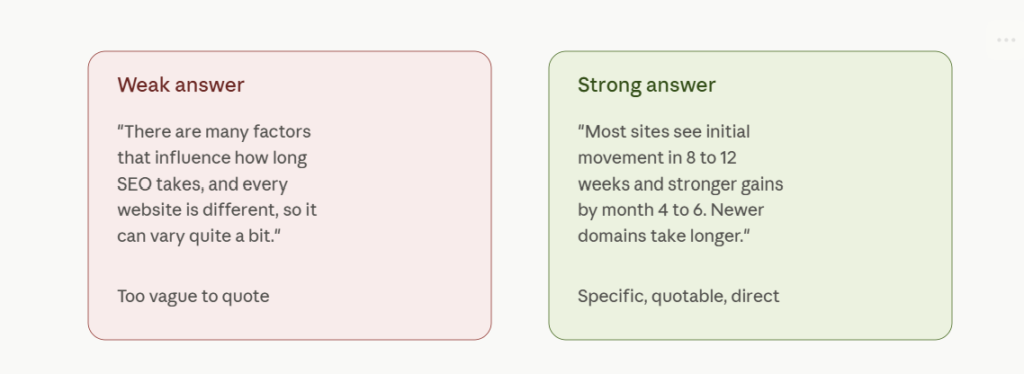
Weak: “There are many factors that influence how long SEO takes, and every website is different, so the timeline can vary quite a bit depending on your situation.”
Strong: “Most sites see initial movement in 8 to 12 weeks and stronger gains by month 4 to 6. Newer domains take longer than established ones with existing authority.”
The second version gives an AI tool something specific to quote. The first gives it nothing.
Step 3: Keep each answer to 2 to 4 sentences
Long FAQ answers stop being FAQs. If an answer needs a full paragraph, it might belong in the main body copy instead, with a shorter summary answer in the FAQ.
Step 4: Use FAQ schema markup
Adding FAQ structured data doesn’t just help with rich results in Google. It gives AI crawlers an explicit, machine-readable signal that says: here is a question, here is its answer. That removes any ambiguity about what part of the page is the direct answer.
Step 5: Match FAQs to each specific service, not the whole company
A generic FAQ block copied across every service page performs worse than a targeted one. Your Technical SEO page should answer technical SEO questions. Your Link Building page should answer link building questions. Overlap is fine, but each page needs its own core set.
Example: What This Looks Like on a Services Page
For a Local SEO service page, useful FAQ questions might include:
- How long before my Google Business Profile shows up in the local pack?
- Do I need a physical address to rank for local searches?
- What happens if I have multiple locations?
- How is local SEO different from regular SEO?
For a Link Building service page:
- How many backlinks do I need per month?
- What’s the difference between a guest post and a paid placement?
- How do you make sure the links are safe for my site?
- Will one bad link hurt my rankings?
Notice these aren’t generic definitions. They’re the specific, practical questions a buyer has right before they decide whether to hire someone.
Does This Help Rankings Too?
Yes, and this is where the two goals overlap again. Google has said clearly that content answering real search intent, in a clear and direct way, performs better in search results. An FAQ section built around real buyer questions is doing exactly that. It’s not a trick aimed only at AI tools. It’s simply well-structured, genuinely useful content, which happens to also be the format AI systems prefer to quote.
Pages with strong FAQ sections tend to earn more “People also ask” placements on Google as a side effect, purely because the content already answers those exact questions in the right format.
A Quick Audit for Your Own Service Pages
Go through every service page and ask:
- Does this page have an FAQ section at all?
- Are the questions ones real buyers actually ask, not generic definitions?
- Does each answer start with a direct, specific response?
- Is FAQ schema markup applied and validating correctly?
- Are the questions different from page to page, matched to that specific service?
If a service page fails more than one of these, that page is missing an easy, high-impact fix.
The Bottom Line
On-page SEO in 2026 isn’t only about hitting a keyword density target or writing the perfect title tag. It’s about making sure every page can answer the exact question a real buyer, or the AI assistant a buyer is using, actually has.
FAQs are the simplest, fastest way to close that gap across an entire site. Start with your highest-traffic service pages, build real FAQ sections around real questions, and the ranking and AI visibility benefits follow the same work.