What Makes a Backlink High Quality? 12 Signals to Evaluate
A high-quality backlink comes from a credible, relevant website, appears in genuine editorial content rather than a forced placement, uses natural anchor text, and reaches a real audience. Domain authority metrics like DR or DA can help with initial screening, but they don’t determine quality on their own. Relevance, editorial context, source credibility, real visibility, and link placement matter more than any single third-party score.
Most link-quality conversations start and end with one number: Domain Rating, Domain Authority, or a similar third-party metric. A link from a DR 70 site gets treated as automatically good. A link from a DR 25 site gets dismissed without a second look.
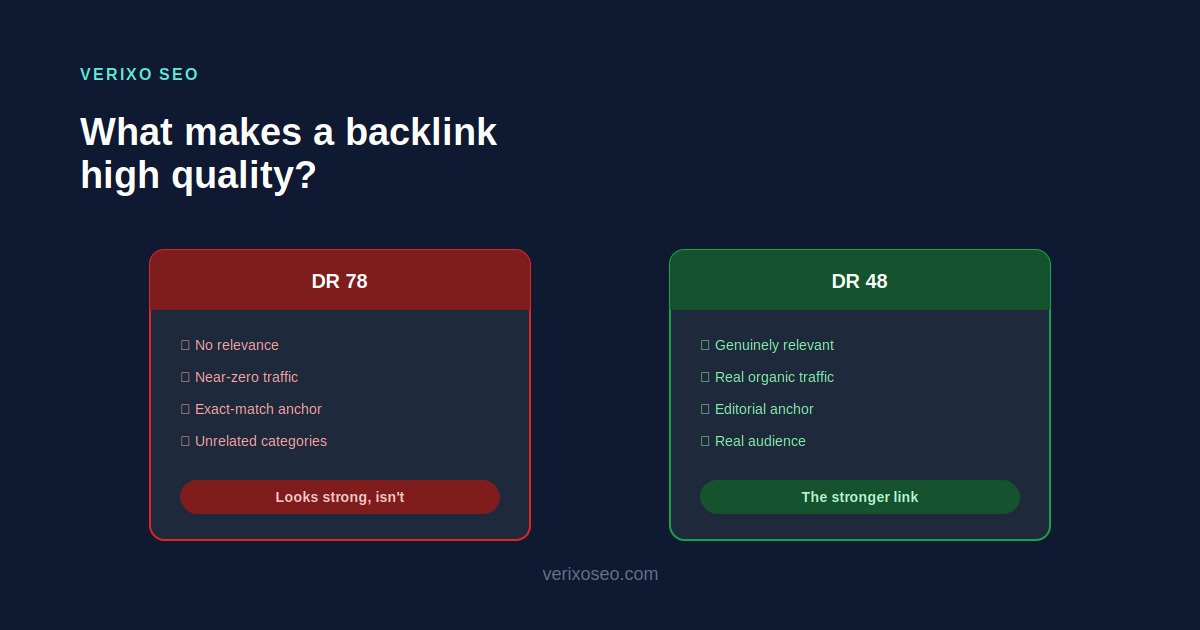
This shortcut misses too much. A high DR guest-post marketplace publishing hundreds of unrelated sponsored articles a week can produce a technically “high authority” link that provides almost no real value. A smaller, genuinely relevant industry publication with real readers can produce a link that matters far more, even at a fraction of the DR score.
This guide walks through the actual signals worth evaluating, in the order they typically matter.
What Is a High-Quality Backlink?
A high-quality backlink is a link that would make sense to a website owner even if search engines didn’t exist: it appears in relevant content, was placed for an editorial reason, comes from a credible source with a real audience, and adds genuine value for the reader who clicks it.
There’s a meaningful difference between three things that often get treated as the same:
A backlink that exists. Technically live, technically pointing to your site. That’s the floor, not the goal.
A backlink that looks impressive in a tool. High DR, high DA, a strong Authority Score. These numbers describe a third-party estimate of a domain’s overall link profile, not the value of any specific link on that domain.
A backlink that genuinely makes editorial and commercial sense. Relevant content, real readers, a placement that would exist independent of any SEO motive.
The rest of this article is a framework for telling these apart.
High-Quality Backlinks: Quick Evaluation Checklist
1. Topical Relevance
Relevance is one of the most practically useful signals available, because it’s something you can evaluate directly rather than estimate through a third-party tool.
A cybersecurity SaaS company getting a contextual link from a respected cybersecurity publication generally makes more editorial and commercial sense than the same company getting a link from an unrelated fashion blog. The cybersecurity publication’s readers are plausibly interested in the SaaS company’s product. The fashion blog’s readers, in nearly all cases, aren’t.
Relevance operates at several levels worth checking separately: site-level relevance (does the domain generally cover topics related to yours), section or category relevance (even a broad publication may have a specific vertical that’s genuinely relevant), page-level relevance (is the specific article your link would appear in actually about something related), and audience relevance (would the people reading this content plausibly care about what you offer).
It’s worth being careful not to overcorrect here. An unrelated link isn’t automatically harmful, and plenty of legitimate, natural link profiles include links from a wide range of sources, since real websites get mentioned in varied contexts over time. The concern is a pattern of exclusively unrelated, obviously placed links, not the occasional link from outside your core niche.
2. Editorial Reason for the Link
A useful mental test: would this link make sense to a reader if SEO didn’t exist as a concept at all?
Strong editorial reasons for a link:
- Citing original research or data
- Recommending a genuinely useful resource
- Quoting or referencing an expert contribution
- Supporting a specific claim with evidence
- Pointing to a relevant tool or service
- Referencing a case study
- Mentioning a company or service directly relevant to the topic
Weak or absent editorial reasons:
- A link forced into a sentence that didn’t need it
- A link with no connection to the surrounding content
- An exact-match commercial anchor dropped into unrelated text
- A new paragraph obviously inserted into old, previously published content solely to add a link
This is often described as “editorial discretion”: the idea that a legitimate publisher makes an independent decision to include a link because it serves the reader, not because payment or exchange determined it. That discretion is one of the clearest markers separating a genuinely valuable link from a manufactured one.
3. Real Search Visibility and Audience
A website with real organic visibility and an actual reading audience is often more meaningful than a site carrying a large third-party authority score but showing little evidence of real traffic.
Worth checking: whether the site has an organic keyword footprint at all, whether specific pages actually rank for relevant terms, whether there’s meaningful branded search volume (a signal of real audience recognition), general traffic trend direction over time, and whether the audience’s likely location and interests match your own target market.
There’s no rigid minimum traffic threshold that makes sense here, and it would be misleading to suggest one. A niche industry publication can have modest overall traffic and still be a genuinely valuable, highly relevant placement, since a smaller but precisely matched audience often outperforms a much larger but irrelevant one in real business terms.
4. Website Credibility
Credibility indicators worth checking: whether there’s a real, identifiable organization or publisher behind the site, whether authors or editors are named and identifiable, whether a genuine About page and contact information exist, whether the site has a consistent publishing history over time rather than appearing suddenly, evidence of subject-matter expertise, a track record and reputation within its space, generally solid editorial content quality, and transparent ownership where that’s relevant to the topic (particularly in areas like health or finance).
Red flags worth noting: anonymous, mass-content operations with no identifiable publisher; hundreds of completely unrelated content categories on one domain; site structures that visibly resemble a guest-post marketplace rather than a publication; fabricated or generic-sounding author profiles; copied or duplicated content; consistently thin pages; and an unusually high ratio of obviously sponsored content relative to genuine editorial output.
No single one of these signals proves a site is a private blog network or link farm on its own. It’s the combination and pattern that matters, and it’s worth evaluating holistically rather than disqualifying a site over one ambiguous signal.
5. Quality of the Linking Page
Domain-level metrics describe an entire website in aggregate. They say very little about the specific page your link would actually live on, and that page is what matters most.
Evaluate the actual page directly: Is it indexed by search engines? Does it contain genuinely useful content, or is it thin filler? Is the topic actually relevant to the link being placed? Does the page show any evidence of ranking or attracting real visitors? Is the link woven into real context, or does it sit awkwardly? Does the page carry an excessive number of outbound links, a common sign of a page built primarily to sell placements? And does the page, on the whole, read like something built for readers or built for link buyers?
This is the practical difference between domain-level and page-level quality: a domain can have a strong overall profile while the specific page hosting your link is thin, unrelated, or clearly monetized primarily through link sales.
6. Contextual Link Placement
Where a link physically sits on a page affects both its relevance signal and its real value to a reader.
Editorial body content, a link embedded naturally within the main article text, generally carries the strongest contextual signal, since it sits directly alongside the content a reader is actually engaging with. Author bio links are common and legitimate, though they carry a different kind of context than an in-body citation. Footer links, sidebar links, and sitewide placements appear on every page of a site regardless of topic, which weakens their contextual relevance regardless of the domain’s overall quality. Directory listings, navigation links, and comment-section links each carry their own, generally weaker, context.
It’s worth being precise here rather than absolute: footer, sidebar, or directory links aren’t automatically worthless, and plenty of legitimate business directories and resource pages provide real value and real referral traffic. The point is that contextual, in-content editorial links generally provide stronger relevance signals and more genuine reader value than placements divorced from any specific content.
7. Natural Anchor Text
Anchor text is one of the more visible signals of whether a link profile looks natural or engineered.
Anchors that generally look natural:
- Brand name (
Verixo SEO) - Bare URL (
verixoseo.com) - Partial-match descriptive phrase (
Verixo SEO's guide to technical SEO) - Product or service name mentioned in context
- Natural descriptive text a writer would genuinely choose
Anchors worth scrutinizing:
- The same exact-match commercial phrase repeated across many different links (
best technical SEO services, used identically dozens of times) - Anchor text with no relationship to the linked content
- Obvious keyword stuffing within the anchor itself
A single link using a commercial phrase as its anchor isn’t automatically a problem. The concern is a pattern: the same aggressive commercial phrase appearing over and over across a link profile, since real editorial linking naturally produces varied, descriptive anchor text rather than repeated exact-match phrases chosen for ranking purposes.
8. Crawlability and Indexability
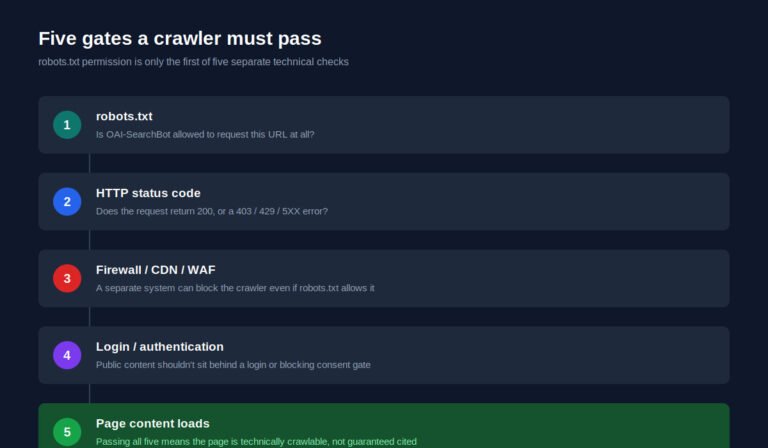
For a backlink to carry its full intended value, the page it lives on generally needs to be accessible enough for search engines to process. Relevant checks: does the page return an HTTP 200 response, is it accessible to crawlers via robots.txt, does it carry a noindex directive, does its canonical tag point to itself or somewhere else, is it reachable directly or does it require following a redirect chain, and does it render correctly.
It’s worth adding nuance here rather than treating this as binary: a page being temporarily noindexed, canonicalized elsewhere, or otherwise imperfect doesn’t automatically make an existing link worthless in every respect (a link can still exist and, in some contexts, drive referral value even from a non-canonical page). But these signals genuinely affect discoverability and the confidence you can have that the link is contributing what you’d expect. A permanently blocked or removed page provides materially less value than a stable, indexed one.
This kind of page-level technical review is part of what Verixo’s technical SEO services cover when assessing a site’s overall link and content health.
9. Outbound Link Quality and Link Neighborhood
Reviewing what else a potential linking page or site links to is a useful diagnostic step.
Worth flagging: a site linking to casino content alongside healthcare, SaaS, pet products, finance, and crypto with no coherent editorial thread connecting them; hundreds of paid-looking commercial anchors scattered across content; a pattern of near-constant guest-post publication with no other content type; outbound links to clearly unrelated destinations; and links pointing toward sites with their own obvious spam signals.
It’s important not to overreact to broad topic coverage on its own. A legitimate, general-interest publication can genuinely and appropriately cover many different subjects. The distinguishing factor isn’t topic breadth, it’s the combination of pattern and editorial behavior: does the variety look like genuine editorial range, or does it look like a marketplace selling placements across every vertical simultaneously.
10. Editorial Standards
Real editorial standards are one of the stronger, if less visible, quality signals. Worth investigating: does the publisher actually edit submitted content, or publish it verbatim? Is there evidence of content being rejected or revised? Are there visible publishing guidelines? Does the site maintain consistent topic and quality standards issue to issue? Does it require credible sourcing for claims? Are authors identifiable rather than generic? Is older content updated over time? And has the site shown any pattern of removing spam or low-quality submissions?
Real editorial friction, meaning it’s genuinely harder to get published there than simply paying a fee, is a positive signal rather than an obstacle. A publisher that pushes back, edits, or rejects submissions is behaving like a real publication rather than a link marketplace.
11. Link Longevity and Stability
A link’s value depends partly on whether it’s likely to remain in place. Consider whether the placement sits on a permanent, actively maintained page or a temporary listing, whether the publisher has a history of deleting old posts, whether URLs on the site tend to change during redesigns, whether the publisher periodically prunes older content, and whether there’s any indication links get quietly removed after a period of time (common with certain paid-placement arrangements).
It’s worth being honest here: no third-party publisher, however reputable, can realistically guarantee a link will remain unchanged forever. Sites redesign, content gets archived, ownership changes. The goal isn’t finding a mythical permanent link; it’s favoring placements on stable, actively maintained sites over those with an obvious pattern of impermanence.
12. Business and Referral Value
Here’s a filter that’s easy to overlook: would you still want this link if search engines provided zero ranking benefit from it at all?
Evaluate the opportunity on its own commercial merits: Would it plausibly send real referral visitors? Does the audience genuinely fit your customer base? Does the placement build meaningful brand exposure or association? Does it come from a source that lends real trust? Could it open a genuine partnership opportunity? Does it support your broader reputation? Could it plausibly generate leads on its own, independent of any SEO effect?
A link that fails this test, one you’d have no interest in if it carried no SEO value whatsoever, is worth extra scrutiny before pursuing, regardless of what a metrics tool says about the domain.
Does Domain Authority or DR Determine Backlink Quality?
No. Domain Authority (Moz), Domain Rating (Ahrefs), Authority Score (Semrush), and similar metrics are proprietary, third-party estimates built by individual SEO tool companies, not figures Google publishes or uses directly as a ranking input. Google does not use Ahrefs’ DR or Moz’s DA as a direct ranking signal.
These metrics can still be genuinely useful as a rough screening tool, a fast way to filter out an initial list of prospects before deeper review. They should not replace direct evaluation of relevance, real traffic, page-level quality, editorial standards, and link context, since two links with an identical DR score can differ enormously in actual value.
Dofollow vs Nofollow: Which Is Better?
It’s worth clarifying terminology first: a standard link with no restrictive rel attribute is often informally called “dofollow,” but that’s not an actual HTML or rel value; it’s simply the absence of a nofollow, sponsored, or ugc attribute. There’s no official “dofollow” tag.
Google’s current guidance on qualifying outbound links recommends rel="nofollow" when you don’t want to vouch for or pass signal to a linked page, rel="sponsored" for links created through advertising, sponsorships, or other compensation, and rel="ugc" for links within user-generated content like comments or forum posts. Since 2019, Google has treated all of these rel values as hints it may consider alongside other signals, rather than as an absolute, binary instruction that a link either passes value or passes none.
This means marketers shouldn’t judge a link opportunity purely by dofollow-versus-nofollow status. A nofollow or sponsored-tagged link from a genuinely relevant, high-traffic publication can still deliver real referral visitors, brand exposure, and audience discovery, value that exists independent of any ranking signal. And a natural, healthy link profile typically includes a mix of both, since real websites accumulate all kinds of links over time, not only unrestricted editorial ones.
What About Paid Backlinks?
Paying for advertisements, sponsorships, partnerships, or content placements is common and legitimate practice across the web. The relevant distinction, per Google’s spam policies, is between compensated placements that are properly disclosed and qualified, and links created primarily to manipulate search rankings, which can violate those policies regardless of how the arrangement is framed.
Where a link involves any form of compensation, product exchange, or commercial arrangement, appropriately qualifying it (typically with rel="sponsored" or rel="nofollow") is the practice Google’s current guidance describes, separate from the question of whether the link itself is otherwise a good editorial fit.
To be direct about what this means in practice: paying for a placement does not automatically make it safe, and paying for a placement on a high-traffic site doesn’t automatically make it safe either, if the underlying intent and execution amount to manipulating rankings. Verixo SEO does not sell or promote paid schemes designed to manipulate rankings through unqualified links, and we do not guarantee that any backlink, purchased or earned, will produce a specific ranking outcome.
Verixo’s approach centers on relevance, editorial quality, and publisher evaluation, reviewing prospective placements against the signals covered throughout this article before recommending them, and being transparent with clients about what a given opportunity is and isn’t. Full backlink packages and pricing are outlined separately for anyone evaluating options.
Guest posting isn’t automatically spam, despite that reputation in some corners of SEO discussion. Quality depends entirely on execution: whether the publication is genuinely relevant, whether real editorial standards apply, whether the contribution serves a genuine purpose beyond link placement, whether the content itself is substantive, and whether links within it behave naturally rather than being stuffed with commercial anchors. A well-placed guest post on a relevant, well-edited publication can be a legitimately strong link. A guest post on an anonymous marketplace accepting anything for a fee is a very different thing wearing the same label.
How to Evaluate a Backlink Opportunity Before Paying or Pitching
A practical, repeatable process:
Step 1: Check topical relevance. Does the site and specific section genuinely relate to your industry or audience?
Step 2: Review organic visibility. Does the domain show real organic traffic and ranking keywords, not just a high authority score?
Step 3: Inspect recent articles. Read a handful of recently published pieces. Do they read as genuine editorial content or as thinly disguised paid placements?
Step 4: Check indexed pages. Are the site’s pages actually indexed, or does a large share appear to be missing from search results?
Step 5: Review outbound linking patterns. What does the site link out to elsewhere? Does the pattern look coherent or scattershot?
Step 6: Check traffic geography. Does the site’s audience location plausibly match your target market?
Step 7: Inspect the proposed page or category. Where specifically would your link live, and does that page meet the quality bar on its own?
Step 8: Review anchor strategy. What anchor text is being proposed, and does it look natural or aggressively commercial?
Step 9: Check link qualification requirements. If compensation is involved, will the link be appropriately qualified per current guidance, and is that acceptable for your goals?
Step 10: Ask whether the link has real business value. Strip away any assumed SEO benefit. Would you still want this placement?
Backlink Metrics We Review
Third-party metrics remain useful as investigative starting points, not as automatic pass/fail rules. Relevant data points typically include organic traffic estimates, traffic trend direction over time, ranking keyword counts, referring domain counts, link growth patterns, geographic traffic distribution, top-performing pages, the range of outgoing domains a site links to, patterns suggesting spam behavior, and general authority metrics as one input among many.
The distinction worth holding onto: these metrics help investigate a link opportunity faster. They shouldn’t replace the direct, qualitative evaluation covered throughout this article.
What Are Toxic Backlinks?
“Toxic backlink” is a term popularized by SEO tools and marketers; it isn’t a formally defined score published by Google itself. Different tools calculate their own version of a toxicity score using their own proprietary criteria, and these scores don’t always agree with each other.
Genuine concerns worth taking seriously include links from manipulative link schemes, links appearing on hacked or compromised sites, automatically generated spam links, private blog network links, links tied to large-scale coordinated link schemes, and unnatural, heavily repeated anchor text patterns pointing at a single site.
It’s also worth understanding that a certain amount of low-quality, spammy-looking links appears naturally on the web for almost every established site, sometimes from scraper sites, spam directories, or automated aggregators with no connection to the site owner at all. This is a normal, background reality of having an online presence, not necessarily evidence of a problem requiring action.
Should You Disavow Low-Quality Backlinks?
Google’s Disavow Links tool exists as an advanced feature, intended for situations where a site has a manipulative link profile it built or acquired (often through a prior, ill-advised SEO campaign) and reasonable efforts to have those links removed directly haven’t worked.
It’s not a routine maintenance task, and a tool flagging a batch of links as “toxic” isn’t, on its own, sufficient reason to submit a disavow file. Submitting a disavow file incorrectly, disavowing a broad swath of harmless or naturally occurring low-quality links, can do more harm than the links themselves were doing.
Situations where professional review may genuinely be warranted include clear evidence of a large-scale, manipulative link-building campaign in a site’s history, a known negative SEO attack, or a manual action received directly from Google referencing unnatural links. Outside of these more specific situations, most sites don’t need to actively manage a disavow file, and there’s no need to treat an unfamiliar or low-quality-looking backlink as an emergency by default.
How Many High-Quality Backlinks Do You Need?
There’s no universal number, and any formula claiming otherwise (something like “10 links equals a top ranking”) isn’t a credible way to think about this.
The right amount depends on a combination of factors: how competitive the target keyword or topic actually is, your site’s existing authority and link profile relative to competitors, the true search intent behind the query, the quality of your own content relative to what’s already ranking, the overall SERP landscape for that topic, general brand strength and recognition, how topically relevant your existing links already are, how well internal linking supports the target page, and, directly, what link profiles your actual competitors in that specific SERP have built.
In practice, a smaller number of genuinely relevant, high-quality links usually outperforms a larger volume of mediocre ones. Chasing a fixed monthly link quota without regard to quality is a weaker strategy than pursuing fewer, better-evaluated opportunities.
Common Backlink Quality Myths
Myth: Higher DR always means a better backlink.
Not necessarily. DR reflects a domain’s overall link profile in one tool’s proprietary model. A high-DR page with no real audience, no relevance, and an obvious link-selling pattern can be worth far less than a lower-DR page that’s genuinely relevant and well-read.
Myth: Every dofollow backlink is valuable.
No. A standard, unrestricted link from an irrelevant, low-quality, or spam-adjacent source provides little value regardless of whether it carries a restrictive rel attribute.
Myth: Nofollow links are useless.
Incorrect. Nofollow and sponsored-tagged links can still drive real referral traffic, brand exposure, and audience discovery, value that exists independent of any ranking signal.
Myth: More backlinks always beat fewer backlinks.
Not reliably. A handful of genuinely relevant, editorially earned links commonly outperforms a large volume of low-relevance or manufactured ones.
Myth: Guest posts are automatically spam.
No. Quality depends on the publisher’s standards, the content’s substance, and the link’s context, not the format itself.
Myth: Every paid link is safe if the site has traffic.
Not accurate. Traffic doesn’t override Google’s spam policies around links intended to manipulate rankings, and unqualified paid links carry real risk regardless of the host site’s traffic level.
Myth: Every low-DR site is bad.
No. Newer or niche publications can have modest DR scores while still being genuinely relevant, well-edited, and valuable.
Myth: A backlink guarantees ranking improvement.
No single link, regardless of quality, guarantees any specific ranking outcome. Rankings depend on many factors working together.
Myth: All links must use keyword-rich anchor text.
No. A natural link profile includes varied anchor text, brand names, URLs, and descriptive phrases, not consistently keyword-stuffed anchors.
Backlink Quality FAQs
What makes a backlink high quality?
A high-quality backlink comes from a relevant, credible source, appears in genuine editorial content, uses natural anchor text, and reaches a real audience. It should make sense independent of any SEO motive.
What is the most important factor in backlink quality?
Relevance is typically the strongest practical starting point, since it’s directly verifiable and closely tied to whether a link would provide genuine value to real readers, separate from any authority metric.
Are high-DR backlinks always good?
No. DR reflects a domain’s overall link profile in a specific tool’s model, not the quality of any individual link or page. Relevance, page quality, and editorial context matter more than the score alone.
Is website traffic important for backlink quality?
Yes, as one signal among several. A site with real organic visibility and an actual audience generally offers more genuine value than a site with an impressive authority score but little evidence of real readers.
Are dofollow backlinks better than nofollow backlinks?
Not automatically. Standard links can pass more direct ranking signal, but nofollow and sponsored-tagged links can still provide real referral traffic, exposure, and audience value. Link quality shouldn’t be judged solely on this attribute.
Are guest post backlinks good for SEO?
They can be, depending entirely on execution: publisher relevance, editorial standards, content quality, and natural link behavior. Guest posting as a format isn’t inherently good or bad.
Are paid backlinks safe?
Paid placements are common practice, but links created primarily to manipulate rankings can violate Google’s spam policies, and paid links generally should be appropriately qualified (typically with rel=”sponsored” or rel=”nofollow”).
What is a contextual backlink?
A contextual backlink is a link placed within the body of relevant editorial content, surrounded by related text, rather than in a footer, sidebar, or unrelated location.
What anchor text should a backlink use?
Natural, varied anchor text: brand names, URLs, partial-match descriptive phrases, or natural language that fits the surrounding sentence, rather than repeated exact-match commercial phrases.
How can I check if a backlink is good?
Evaluate relevance, editorial reason, page and site credibility, real traffic, anchor text, placement context, indexability, and outbound link patterns together, rather than relying on any single metric.
How many backlinks do I need?
There’s no universal number. It depends on competition, existing authority, content quality, and what competitors ranking for the same terms have built. Quality and relevance generally matter more than hitting a fixed quota.
Can a bad backlink hurt SEO?
A single low-quality link rarely causes meaningful harm on its own. Large-scale, manipulative link patterns, or links tied to a known penalty or negative SEO situation, are the scenarios where genuine risk exists.
Final Thoughts: Evaluate Links Like a Publisher, Not Just an SEO Tool
A high-quality backlink should make sense from every relevant angle at once: it fits the content, it serves the reader, it reflects well on the brand, and it’s something a real publisher would have genuine editorial reason to include.
Third-party SEO metrics are useful for fast initial screening, but they can’t replace human evaluation of relevance, editorial quality, real audience, credibility, and natural placement. The businesses building durable authority over time are the ones evaluating opportunities this way, not the ones optimizing purely for the highest DR number available.